DC System Modelling
DC node

DC node equivalent circuit

DC node equivalent circuit
The AC node is modeled using voltage \(U_d\) where [1]:
\(U_d\) is the voltage magnitude in pu
\(P_{rg}\) is the active power injection of renewable generation in pu
\(P_{cn}\) is the active power injection of converter in pu
\(P_l\) is the active power demand in pu
Class Reference: pyflow_acdc.Classes.Node_DC
- class Node_DC(node_type, kV_base, Voltage_0=1, Power_Gained=0, Power_load=0, name=None, Umin=0.95, Umax=1.05, x_coord=None, y_coord=None, S_base=100)
DC bus in the network.
- Parameters:
node_type (str) – Bus type:
'Slack','P','Droop', or'PAC'(stored astype).kV_base (float) – Base voltage in kV.
Voltage_0 (float, optional) – Initial voltage magnitude in pu (stored as
V_ini).Power_Gained (float, optional) – Active power injection in pu (stored as
PGi).Power_load (float, optional) – Active power demand in pu (stored as
PLivia load factors).name (str, optional) – Bus identifier.
Umin (float, optional) – Minimum voltage magnitude in p.u.
Umax (float, optional) – Maximum voltage magnitude in p.u.
x_coord (float, optional) – x-coordinate, preferably in longitude decimal format.
y_coord (float, optional) – y-coordinate, preferably in latitude decimal format.
S_base (float)
- price
Nodal energy price when the bus belongs to a price zone.
- Type:
float
- PLi_factor
Time-series/scenario load scaling factor.
- Type:
float
- PLi_inv_factor
Investment-period load scaling factor.
- Type:
float
Example Usage:
import pyflow_acdc as pyf
# Create an DC node
pyf.initialize_pyflowacdc()
node = pyf.Node_DC('P', 1, 0,0,525,name='Bus1')
DC line
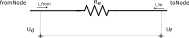
DC line model

DC line model
Class Reference: pyflow_acdc.Classes.Line_DC
- class Line_DC(fromNode, toNode, r=0.001, MW_rating=9999, Length_km=1, polarity=Polarity.MONOPOLAR, name=None, N_cables=1, Cable_type=CableType.CUSTOM, S_base=100)
DC transmission line or cable.
- Parameters:
fromNode (Node_DC) – Starting bus of the line.
toNode (Node_DC) – Ending bus of the line.
r (float, optional) – Resistance in pu.
MW_rating (float, optional) – MW rating of one cable.
km (float, optional) – Length of the line in km (stored as
Length_km).polarity (str, optional) – Polarity:
'm'(monopolar),'b'(bipolar), or'sm'(symmetric monopolar).name (str, optional) – Line identifier.
N_cables (int, optional) – Number of parallel cables (stored as
np_line).Cable_type (str, optional) – Cable type from the built-in database, or
'Custom'.S_base (float, optional) – Per-unit power base in MVA.
Length_km (float)
Example Usage:
import pyflow_acdc as pyf
# Create an AC node
pyf.initialize_pyflowacdc()
node1 = pyf.Node_DC('Slack', 1, 0,0,525,name='Bus1')
node2 = pyf.Node_DC('P', 1, 0,0,525,name='Bus2')
# In pu
line_1 = pyf.Line_DC(node1, node2, r=0.01, MW_rating=100, N_cables=1, name='Line1')
# Or by cable type in database
line_2 = pyf.Line_DC(node1, node2, S_base=100, Length_km=100, Cable_type='NREL_525kV_2500mm2')
DC line expansion
DC expansion model
DC expansion model
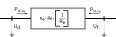
The expanded branch object is inside the Line_DC class.
The expanded branch \(e\) is modelled as:
DCDC converter
DCDC converter model
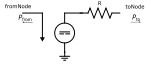
DCDC converter model
The DCDC converter is modelled very simply, with the set power injected into the toNode and the power drawn from the fromNode.
To include losses there is a simple resistive model. For power flow calculations the power injected in either node is kept constant as the losses are pre calculated with the assumption of \(V_{to} = 1 pu\).
Class Reference: pyflow_acdc.Classes.DCDC_converter
Key attributes:
Attribute |
Type |
Description |
|---|---|---|
|
Node_DC |
The starting node |
|
Node_DC |
The ending node |
|
float |
Resistance of the converter |
|
float |
Power set point of the converter |
|
float |
Power rating of the converter |
|
str |
Name of the converter |
|
str |
Geometry of the converter |
Example Usage:
import pyflow_acdc as pyf
# Create an AC node
pyf.initialize_pyflowacdc()
grid = pyf.Grid(S_base=100)
node1 = pyf.Node_DC('Slack', 1, 0,0,525,name='Bus1')
node2 = pyf.Node_DC('P', 1, 0,0,525,name='Bus2')
conv = pyf.add_DCDC_converter(grid,node1 , node2 ,Pset=0.1, r=0.0001, MW_rating=99999,name='DCDC1')
Inputs can be given in MW or pu. For pu use the r and Pset parameters. For MW use the R_Ohm and P_MW parameters.
References